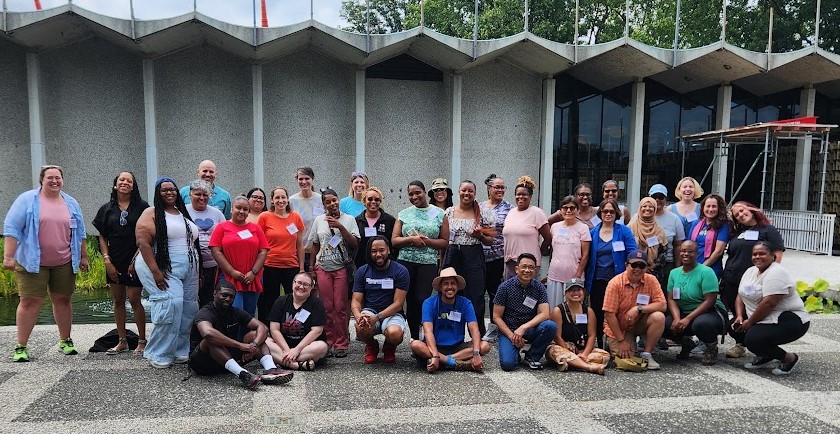


2026 Summer Institute for Garden-based Teaching
July 14-17, 2026
Overview
The Summer Institute for Garden-Based Teaching is a four-day training, consisting of 30 hours of intensive in-person training for K-5 District of Columbia Public Schools and public charter school teachers.
Watch this video to hear from the educators who attended the 2025 Summer Institute.
If you would like to receive an email when the application for the 2027 Summer Institute for Garden-based Teaching is available, please complete the short form below.
Summer Institute for Garden-based Teaching interest form.
Application Deadline and Notification of Acceptance
Applications will be available in early spring. Applications will receive notification of acceptance on a rolling basis until full.
Eligible participants
- Are associated with a DCPS or public charter school (teacher, staff, or administrator) that has an existing school garden program
- Apply with at least one other school team member
- Commit to attend all 30 hours of the institute
All participants receive a stipend. Stipend amounts are contingent upon finalized funding.
Participants will learn
- Outdoor group management techniques
- Garden-based lessons across content areas that connect to the K-5 Next Generation Science Standards (NGSS) and Common Core State Standards
- How to sustain a school garden program
- Basics of garden design and maintenance
- Benefits of garden-based learning and teaching
Why does the Office of the State Superintendent of Education (OSSE) support the Summer Institute for Garden-Based Teaching?
More than half of all DCPS and public charter schools in the District have school gardens. However, only 21 percent of educators at these schools use the school garden for teaching. The top three barriers identified by educators and administration at schools with gardens are:
- Time constraints
- Lack of help or assistance in the garden
- Lack of teacher involvement or interest
Through the data collected by the OSSE School Gardens Program using the University of Texas School Garden Sustainability Survey and the School Garden Registration Form, there is an opportunity to better support classroom teachers to engage students using garden-based instruction while utilizing school gardens as a tool for standards-based instruction.
Research also shows that learning in natural environments can boost performance in reading, writing, math, science, and social studies (A.E. Pigg, 2006; James, 2010) and reduce stress, anger, and aggression (Chawla, 2014). Also, teachers who work in schools with garden programs have higher workplace morale and increased “general satisfaction with being a teacher at that school” (Skelly & Bradley, 2000).
Questions about the Summer Institute? Email Sam Ullery at [email protected].
Interested in learning more? Visit the Friends of the National Arboretum School Garden Support Program page.