


OSSE reports both four-year and five-year adjusted cohort graduation rates (ACGR) for public schools in the District, in accordance with US Department of Education guidelines. We calculate these rates by taking the number of students who graduate with a regular high school diploma in either four or five years and divide by the number of students who form the adjusted cohort for the graduating class. The methodology used to calculate the ACGR is the most accurate way to understand graduation patterns across the District but also at the sector (DC Public Schools (DCPS) or charter), local education agency (LEA), and school levels, and its design keeps students from falling through the cracks as it ensures that a school remains accountable for each student’s progress toward graduation.
Understanding the ACGR
Calculating the ACGR may sound easy, but the word adjusted adds a little complexity. Students who are entering ninth grade for the first time in a school year form a cohort, which is then adjusted by adding any students who transfer into the cohort later during the next three (or four) years and subtracting any students who transfer out, emigrate to another country, or are deceased during that same period. For example, if a student moves into a public school in the District in 10th grade and graduates after 12th grade, we count them. Conversely, if a student enrolls in a diploma-granting school in 11th grade for the 2023-24 school year through an official exchange program and the student or their parent/legal guardian provide evidence that the exchange program has been completed following that year, the student is removed from the 2021-22 first ninth-grade year cohort. Adjusting the cohort is important so that we accurately capture all potential graduates for reporting purposes, but tracking students over time does make calculating the ACGR very complicated.
Recent Findings
For six of the last seven years, graduation rates have risen in the District (see Figure 1). The year where the graduation rate didn’t increase (2022-23 to 2023-24), it stayed the same as the previous year.
Specifically, the four-year ACGR for the 2024-25 school year increased by 2.6 percentage points over the previous school year, with 78.7 percent of students in the District graduating high school in four years. The five-year graduation rate for the 2024-25 school year is 80.2 percent, which is a 1.4 percentage-point increase from the previous school year.
Figure 1. Multi-Year District of Columbia Statewide 4-Year Adjusted Cohort Graduation Rate
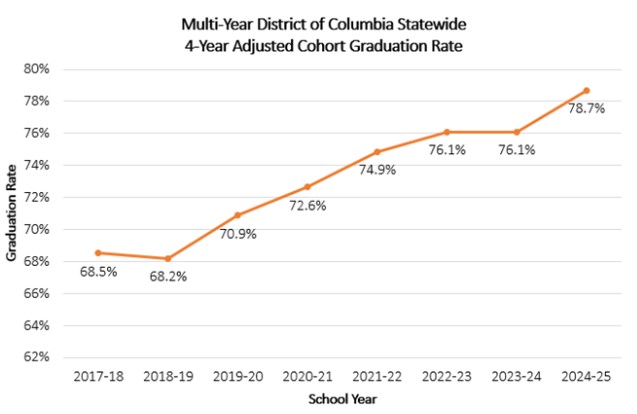
Since the 2011-12 school year, the four-year adjusted cohort graduation rate for the District has increased by more than 18 percentage points (see Table 1).
Table 1. Multi-Year District of Columbia Statewide 4-Year Adjusted Cohort Graduation Rate

In addition to calculating rates for District students overall, we also look at rates for students served by DC Public Schools (DCPS) and students served by public charter schools (see Table 2). The four-year graduation rate for DCPS is 77.6 percent, an increase of 0.8 percentage points from the previous year. The five-year graduation rate is 79.7 percent, an increase of 2.5 percentage points. The four-year graduation rate for public charter schools (PCS) is 83.0 percent, an increase of 5.5 percentage points from the previous year. The five-year PCS graduation rate is 83.2 percent, a slight decrease of 0.1 percentage points from last year’s proceeding cohort. However, this 83.2 percent five-year graduation rate is still impressive as it reflects a 5.7 percentage-point increase from the four-year graduation rate for this same cohort (77.5 percent) reported last year.
Table 2. SY2024-25 ACGR Rates Across Sectors
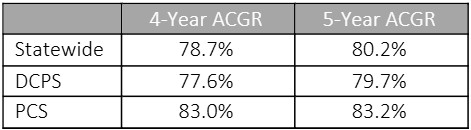
OSSE also reports graduation rates for various student groups. We have seen increases in graduation rates for many student groups for both the four-year and five-year graduation rates (see Tables 3, 4, and 5).
Table 3. ACGR Rates Across Race/Ethnicity

Table 4. ACGR Rates Across Student Group

One important note is that some student groups are small. As part of OSSE’s Student Privacy and Data Suppression Policy, we do not report on student groups below the minimum n-size of 10 students. As such, some subtotals may not sum to the total number of students because these student groups are not reported in these data.
If you want to take a deep dive into our graduation data, please check out the public files. We share all public data in Excel files so you can easily explore the data or import it into a data visualization application.
Related content: OSSE Blog